
The Physics of Execution: The "Early Stage" Trap in Radiopharmaceuticals

Byron Fitzgerald
Founder, ProGen Search
1. Executive Summary
The contemporary biotechnology investment landscape has bifurcated into two distinct realities. On one side, unprecedented capital inflows - exemplified by Bristol Myers Squibb’s $4.1 billion acquisition of RayzeBio and Eli Lilly’s $1.4 billion purchase of Point Biopharma - signal a massive, empirically driven validation of the radiopharmaceutical modality. On the other, a rising tide of operational failures, regulatory stalls (Complete Response Letters), and supply chain fractures suggests that the industry’s understanding of execution risk is dangerously immature.
The prevailing heuristic in biotechnology governance treats "Phase 1" as a flexible zone of scientific inquiry - a proof-of-concept gateway focused primarily on safety and pharmacokinetics. In this traditional model, capital intensity is low, manufacturing is often outsourced to generalist vendors, and supply chains are decoupled from clinical execution. For Radioligand Therapies (RLTs), this heuristic is not merely inaccurate; it is a source of strategic failure.
This report establishes that the "Early Stage" label is a misnomer for Radiopharmaceuticals. Due to the immutable physics of isotope decay, the logistical rigor required to dose the first patient in a Phase 1 trial is nearly identical to that required for a commercial product launch. Unlike traditional modalities where risk decreases linearly as biological targets are validated, radiopharma risk profiles are inverted: execution risk spikes exponentially at the transition from Phase 1 to Phase 2.
Our forensic analysis of sector data identifies specific, recurring failure modes that are often invisible to generalist boards until it is too late:
The "Structural Lock-In": The interplay between the isotope, chelator, and linker creates a rigid design constraint early in development. Minor chemical modifications to improve manufacturing yields often invalidate prior dosimetry, forcing costly regulatory restarts (New INDs) rather than simple amendments.
The "Just-in-Time" Mandate: There is no inventory buffer in this sector. A supply chain failure is a clinical failure, as deviations in delivery time directly alter the specific activity and dose delivered to the tumor.
Leadership Timing as a Predictive Variable: Analysis confirms that the timing of appointing Technical Operations and CMC leadership is the primary variable predicting success. Programs that delay these hires until Phase 2 consistently face "comparability cliffs" and regulatory rejection.
The Waste Bottleneck: A critical failure mode for alpha-emitter programs (e.g., Actinium-225) is not efficacy, but site activation failure due to "waste limit" caps, where hospitals reject trials based on storage capacity rather than medical merit.
The companies that will win are those that treat Phase 1 not as an experiment, but as a commercial rehearsal.
2. The Illusion of "Early Stage": Structural Divergence and Lock-In
In the standard biotechnology operating model, the transition from "Lead" to "Candidate" is fluid and forgiving. If a Phase 1 small molecule demonstrates poor oral bioavailability or solubility, medicinal chemists can engage in extensive Structure-Activity Relationship (SAR) studies. They might tweak salt forms, polymorphs, or excipients to optimize the drug's performance. Crucially, these are often considered "CMC changes" (Chemistry, Manufacturing, and Controls) that can be handled via protocol amendments or bridging studies without invalidating the entire body of preclinical safety data.
For radiopharmaceuticals, this flexibility is an operational illusion. The drug is a complex conjugate system comprising three distinct functional units: the Targeting Vector (ligand), the Linker, and the Chelator. The choice of these components dictates not only affinity but also the biodistribution and excretion pathway of the radioactive payload.
The Lead Optimization Paradox: Iteration vs. Lock-In
The critical divergence lies in the biodistribution sensitivity of this conjugate. In small molecules, changing a peripheral methyl group to an ethyl group might slightly alter potency. In radiopharmaceuticals, changing the chelator - for example, switching from DOTA to MACROPA for Actinium-225 labeling to improve stability - fundamentally alters the dosimetry profile.
Research indicates that even minor modifications to linker chemistry can drastically change uptake in "sink" organs like the kidneys or bone marrow. In a small molecule program, a toxicity signal might be managed by dose reduction or formulation change. In radiopharma, the toxicity is intrinsic to the molecular residence time of the isotope in that organ. If a chelator releases the isotope prematurely (de-chelation), the free isotope will traffic to bone or liver, causing off-target toxicity that cannot be "formulated away."
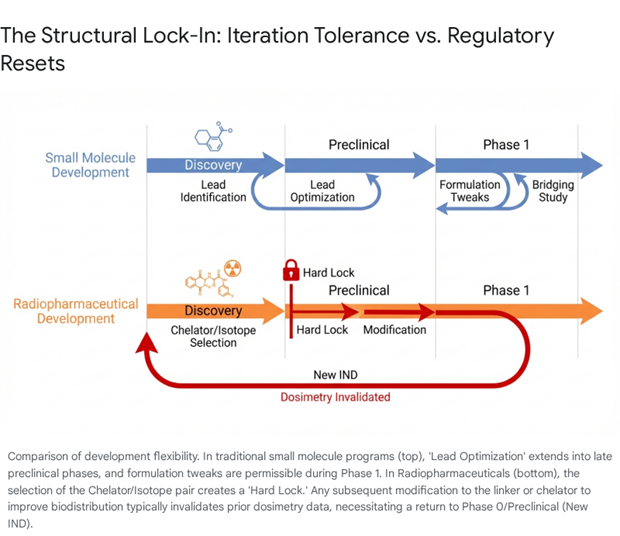
As illustrated in the diagram above, this creates a phenomenon of "Structural Lock-In." Any attempt to modify the molecule to solve a manufacturing yield issue effectively creates a new molecule in the eyes of the regulator. This change invalidates the prior dosimetry and toxicology package, often necessitating a full regulatory restart (New IND) rather than a simple amendment.
Consider a hypothetical scenario: A Phase 1 program utilizing a Lead-212 isotope discovers that its chelator is unstable at room temperature, requiring complex cold-chain logistics that clinical sites cannot support. In a standard biotech program, the team would simply reformulate the drug. In radiopharma, stabilizing that chelator likely changes the bond structure or the linker length. This new structure will have a different renal clearance profile. The kidney dosimetry data generated in the first 10 patients is now scientifically irrelevant to the new molecule. The program does not just pause; it resets to the preclinical stage.
Therefore, the "learning phase" of Phase 1 does not exist in the traditional sense. The molecule must be commercially viable in its structural integrity before the first patient is dosed. The "fail fast" mantra of biotech is dangerous here if the failure requires a restart rather than a pivot.
The Thermodynamics of Value Loss
The second structural divergence is the physics of decay. Traditional pharmaceutical ingredients can be stockpiled, warehoused, and shipped via standard logistics channels. Medical radioisotopes are decaying assets from the moment of their generation.
The half-lives of critical isotopes impose a strict operational radius. Lutetium-177 has a half-life of approximately 6.7 days, while Actinium-225 is roughly 10 days. Lead-212 is even more constrained at 10.6 hours. This physics constraint couples the reactor or accelerator schedule directly to the patient's infusion chair.
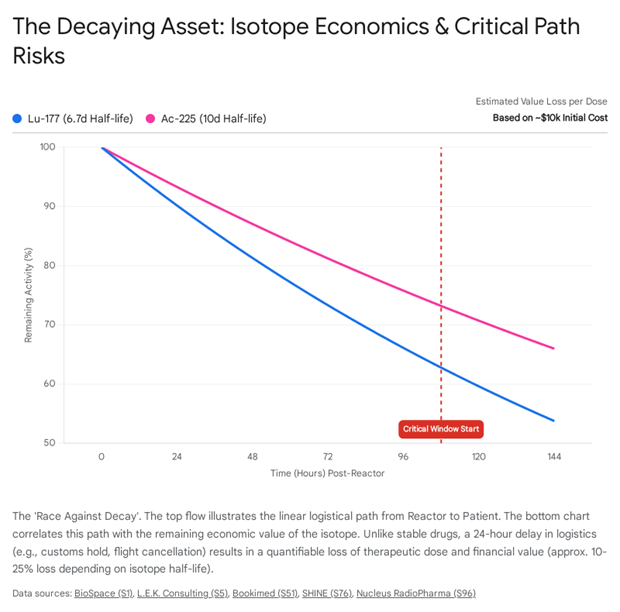
As the decay curve above dictates, a logistical delay is not just a timing issue; it is a destruction of economic and clinical value. A 24-hour delay - caused by a customs hold, a missed flight connection, or a snowstorm - can render a dose clinically unusable due to the loss of specific activity (the ratio of radioactivity to mass).
For a Phase 1 trial, this implies that the supply chain must function with commercial-grade precision for every single dose. A missed shipment means the drug literally disappears. The costly isotope is wasted, the manufacturing slot is lost, and critically, the patient - who may have been pre-treated with harsh regimens - misses a therapy window.
Therefore, supply chain robustness is a clinical efficacy variable. If the supply chain varies, the specific activity varies, and the effective dose delivered to the tumor varies. Regulators are increasingly scrutinizing this variability, demanding tighter specifications on "End of Synthesis" and "End of Shelf Life" activity levels that amateur supply chains cannot meet.
The Theranostic Dependency
Further complicating the "early stage" label is the regulatory requirement for co-development. Most RLTs are "theranostic" pairs: a diagnostic imaging agent (typically using a positron emitter like Gallium-68 or Fluorine-18) is used to screen patients for the therapeutic target (using a beta or alpha emitter like Lutetium-177 or Actinium-225).
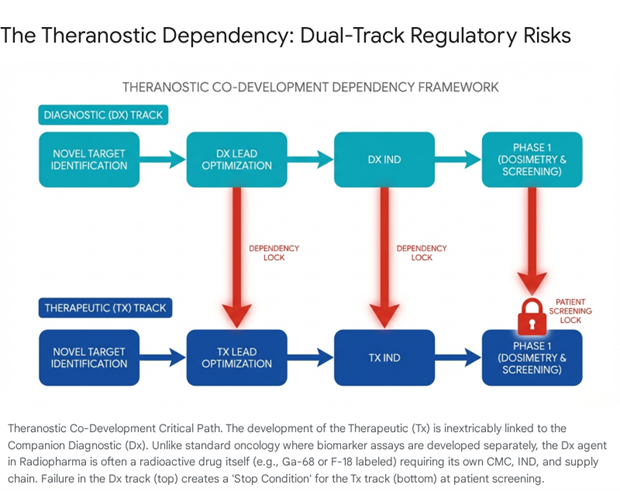
This creates a dual-track regulatory dependency that does not exist for traditional monotherapies. As shown in the critical path diagram, the development of the Therapeutic (Tx) is inextricably linked to the Companion Diagnostic (Dx). A delay in the diagnostic track - whether due to imaging isotope shortages, image quality validation issues, or manufacturing failures - creates a "hard stop" for the therapeutic track.
You cannot enroll a patient you cannot see. If the diagnostic agent is novel (e.g., a new FAP or Integrin tracer), the sponsor essentially has to run two full drug development programs in parallel. Boards often approve budgets for the therapeutic trial while underestimating the capital and operational complexity required to validate the companion diagnostic simultaneously. We have observed multiple programs where the therapeutic asset is ready, but the trial is stalled for 6-12 months because the diagnostic IND is lagging, or because the imaging agent supply chain cannot reach the same sites as the therapeutic agent.
3. The Organizational Architecture: Why Structure Predicts Success
The structural divergences described above mandate a different organizational design. However, forensic analysis of sector delays reveals a persistent "Scientific Founder Syndrome," where operational leadership is hired too late to influence the critical path.
The "Too Late" Hiring Curve
In the "Standard Biotech" model, a Chief Supply Chain Officer (CSCO) or Head of Technical Operations is typically a commercial-stage hire, often brought in during Phase 3 to prepare for launch. In Radiopharma, this role is existential at the Seed/Series A stage.
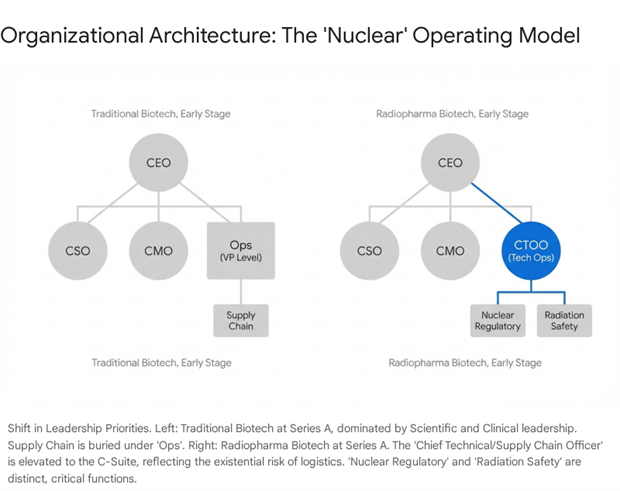
Successful "Nuclear Biotechs" elevate the Technical Operations role to the C-suite early. The CEO cannot manage the complexity of reactor schedules, regulatory licensing for isotopes, and cross-border "hot" logistics alongside fundraising and clinical strategy. The operational burden is too high and specialized.
In a traditional biotech, the Chief Medical Officer (CMO) drives the timeline. In a radiopharma biotech, the Chief Technical Officer (CTO) or Head of Operations drives the timeline, because the clinical trial cannot open until the radioactive materials license is amended and the supply chain is validated. Boards that fail to recognize this power shift often find their CMOs frustrated and their trials stalled, waiting for isotopes that never arrive.
4. The Execution Wall: Where Risk Actually Enters the System
Investors and Boards often model risk as a descending curve: as biological targets are validated in the clinic, the probability of success (PoS) is assumed to increase. In radiopharma, this mental model is flawed. While biological risk decreases after Phase 1 imaging confirms tumor uptake (the "see it, treat it" principle), Execution Risk rises exponentially.
The Inflection Point: Phase 1b to Phase 2a
The earliest and most lethal inflection point is the transition from a boutique Phase 1 trial to a multi-center Phase 2 expansion. This is the "Execution Wall."
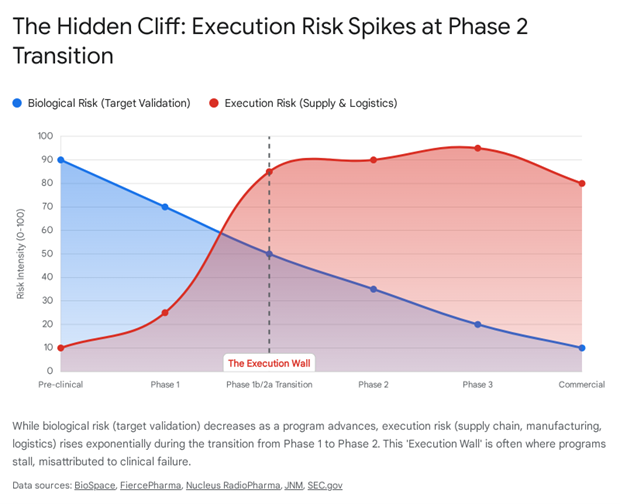
In Phase 1, a program can survive on "artisanal" execution. Patient cohorts are small (3-6 patients per dose level), and recruitment is often confined to a single high-volume academic center with an on-site hot cell and a dedicated radiochemist. This environment allows for manual synthesis and "hand-carried" logistics. The Principal Investigator (PI) often acts as the manufacturing quality control, manually compounding doses in the hospital basement.
However, this success is a false positive for scalability. To accrue 50-100 patients for a Phase 2 trial, the sponsor must activate 10-20 sites across multiple geographies (North America, Europe, APAC).
The Manual Process Failure: The manual processes that worked for 5 patients fail for 50. Variation between different radiochemists at different sites introduces data noise that can ruin the trial.
The Logistical Fracture: The logistical network that supported one site cannot support a global footprint. Shipping to a single known academic center is vastly different from coordinating JIT deliveries to community oncology centers in different time zones.
The Regulatory Shift: The regulatory oversight shifts from local IRB flexibility to FDA/EMA strictness on centralized manufacturing.
It is at this juncture - Phase 1b/2a - that the physical constraints of radioisotope half-lives collide with the rigid frameworks of Good Manufacturing Practice (GMP) and global logistics. Programs often stall here for 12-18 months as they attempt to retrofit a commercial supply chain onto a clinical program that was designed for academic convenience.
5. Manufacturing Constraints: The Zero-Rework Reality
In scaling from Phase 1 to Phase 2, manufacturing typically moves from a hospital pharmacy or academic lab to a commercial Contract Development and Manufacturing Organization (CDMO). This "tech transfer" exposes the fragility of the process and reveals the "Zero Rework" constraint.
The Incompatibility of Rework
In the world of standard biopharmaceuticals (e.g., monoclonal antibodies), manufacturing deviations are common but manageable. If a batch has a pH excursion or filtration issue, it can often be "reprocessed" or "reworked" - subjected to additional purification steps to bring it back within specification. This flexibility provides a safety net that protects the clinical supply.
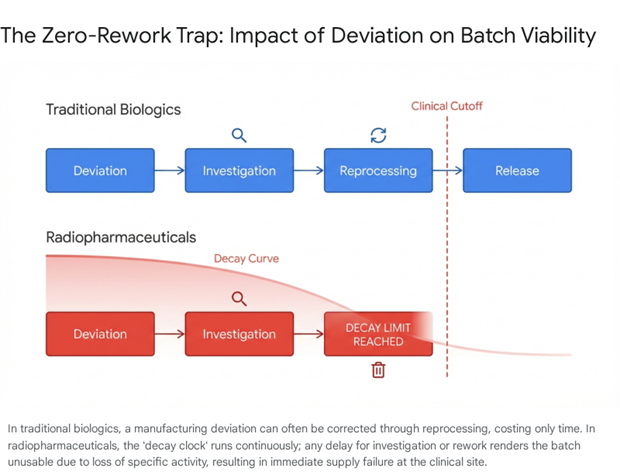
In radiopharmaceuticals, this safety net does not exist. The radiopharmaceutical batch release testing is a race against the clock. By the time a deviation is identified and an investigation is launched, the isotope has decayed beyond its useful life. Even if a rework protocol could be executed in a few hours, the specific activity (radioactivity per mass of drug) would likely fall below release specifications due to the decay of the isotope during the rework period.
This means that radiopharmaceuticals are often released via parametric release - released based on process data rather than final sterility results - because there is no time to wait for a 14-day sterility test. Consequently, process robustness must be absolute.
A batch failure rate of 20-30% during the initial months of Phase 2 - common in "tech transfer" scenarios where manual processes are automated - is fatal here. Unlike a pill that can be taken from inventory, a failed radiopharma batch results in:
Immediate Missed Dose: The patient is sent home, potentially after traveling hours to the site.
Wasted Capital: The isotope is paid for regardless of batch success (often $10k-$20k per dose raw material cost).
Erosion of Trust: Investigators will stop enrolling patients if they cannot rely on the drug arriving.
The Tech Transfer "Valley of Death"
The transition from manual synthesis (Phase 1) to automated cassette-based systems (Phase 2) is a primary point of failure. A manual filtration step that works when done by a skilled chemist often fails when performed by a robotic arm pushing liquid through a filter under high pressure. This "Tech Transfer" often reveals that the manual process is not robust enough for automation, leading to high failure rates right as the trial attempts to scale. Boards should treat the "Tech Transfer" milestone as a higher risk event than the First Patient In (FPI).
6. Supply Chain Fragility and Scarcity Traps
The radiopharmaceutical supply chain is unique in its fragility. It relies on a limited number of aging nuclear reactors and a nascent infrastructure of particle accelerators. A single point of failure can cascade through the entire industry.
The Actinium-225 Scarcity Trap
The market for high-value alpha-emitters like Actinium-225 is severely constrained, creating a "Scarcity Trap" for late-mover programs. While new accelerator-based production methods are coming online, current demand vastly exceeds supply.
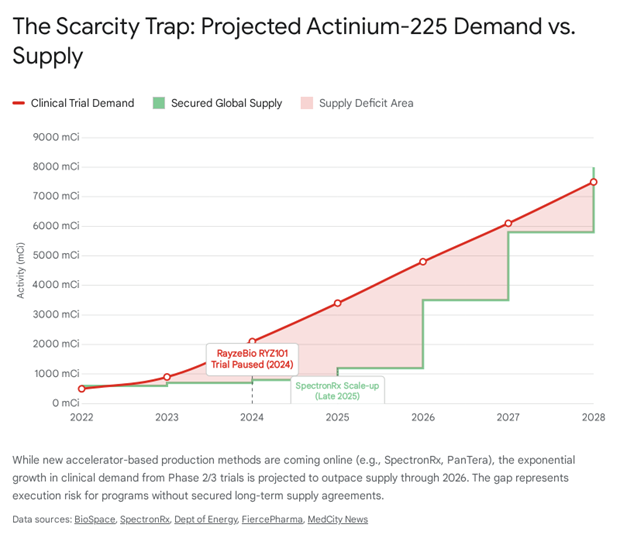
As the supply/demand projection demonstrates, clinical trial demand is currently outstripping secured global supply. Companies that have not secured "take-or-pay" reservation agreements - negotiated years in advance - find their trials paused. The RayzeBio Phase 3 pause was a definitive public example of this risk; the trial was halted not because the drug was ineffective, but because the supply chain could not support the clinical volume.
This highlights that isotope security is a governance issue, not just a procurement detail. A Letter of Intent (LOI) from a supplier is meaningless in a shortage; only binding capacity reservation agreements protect the asset. Late-stage programs are effectively bidding against each other for the same limited millicuries of activity.
The Generator Dependency (Lead-212)
Some developers have pivoted to Lead-212, which uses a generator system (Radium-224) to produce the isotope on-site. While this theoretically decouples the site from daily logistics, it introduces a new dependency: the parent isotope, Thorium-228, is itself supply-constrained and centrally produced.
Furthermore, the extremely short half-life of Lead-212 (10.6 hours) means a centralized manufacturing model is nearly impossible for global Phase 2 trials. To execute a global trial, a sponsor must establish regional manufacturing hubs (e.g., US, EU, APAC) before the trial can scale. This effectively triples the CMC burden and tech transfer risk at a very early stage of development.
7. The Last Mile: Site Activation and the Waste Bottleneck
Even if the isotope is secured and the drug is manufactured successfully, the program faces a third execution barrier: the clinical site itself. The assumption that "if you build it, they will come" is demonstrably false in radiopharmaceutical trials due to unique licensing and infrastructure requirements.
The Licensing Labyrinth
Before a hospital can enroll a single patient, it must possess a Radioactive Materials License (RAM) specifically authorizing the exact isotope in the trial. A site licensed for diagnostic Technetium-99m or Fluorine-18 is not automatically licensed for therapeutic Actinium-225 or Lead-212. Adding a new isotope requires an amendment with the Nuclear Regulatory Commission (NRC) or state regulators, a process that typically takes 3-6 months.
The Invisible "Waste Cap"
For alpha-emitters, the most acute "silent killer" of site activation is radioactive waste management.
Alpha-emitters like Ac-225 decay into a chain of daughter isotopes (e.g., Francium-221, Bismuth-213) that remain radioactive. The regulatory requirements for disposing of contaminated materials (gloves, tubing, syringes, diapers) are strict. Many hospitals rely on waste brokers who may refuse to accept these specific isotopes because their own licenses do not cover the daughter nuclides.
If off-site disposal is impossible, the hospital must store the waste on-site for "decay-in-storage" - typically for 10 half-lives. For Ac-225 (10-day half-life), this means storing waste for 100 days.
However, hospital nuclear medicine departments often have severely limited physical space - sometimes just a few closets in a basement. Storing 100 days' worth of radioactive waste for a high-volume Phase 2 trial is physically impossible for many sites. Consequently, Radiation Safety Committees (RSCs) are increasingly rejecting trial protocols to prevent their facilities from becoming radioactive waste dumps. This effectively caps patient enrollment based on square footage, not patient eligibility.
8. The CMC Readiness Gap and Comparability Cliffs
A recurring cause of program delay is the "CMC Readiness Gap." This occurs when organizations treat radiopharmaceutical development with the same sequential logic as traditional drugs, assuming manufacturing rigor can be "dialed up" in later phases.
The "Retrofit" Trap
In traditional biotech, "phase-appropriate" GMP allows for looser controls in early phases. In radiopharma, the FDA expects that by Phase 3, the manufacturing process is fully implemented and identical to the commercial process.
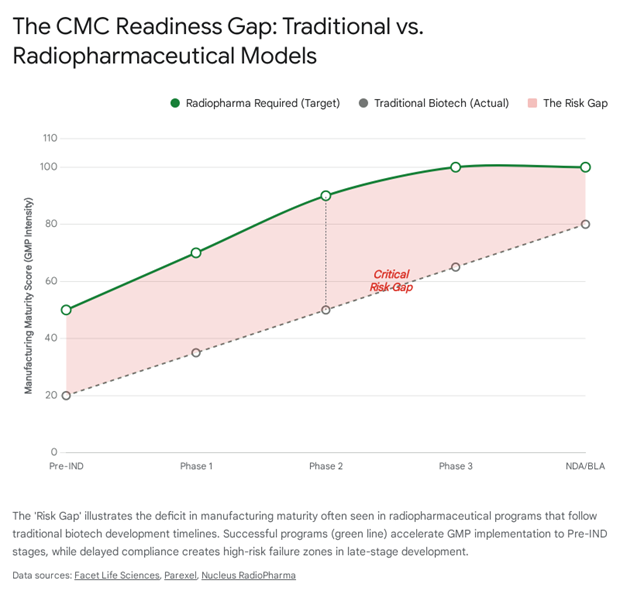
As the chart illustrates, radiopharma requires commercial-grade aseptic processing and analytical methods much earlier in the lifecycle (Pre-IND/Phase 1) compared to traditional biotech. This is due to the reliance on parametric release and short half-lives. Programs that follow the standard biotech curve often encounter a "Comparability Cliff" in Phase 3.
The Comparability Cliff: Telix Case Study
This happens when the manufacturing process used in early trials (often manual) is different from the commercial process (automated). If the impurity profile shifts even slightly during this scale-up, regulators may determine that the commercial product is not "comparable" to the clinical trial material.
This was the specific failure mode for Telix Pharmaceuticals' TLX250-CDx. Despite a successful Phase 3 trial, the FDA rejected the BLA because Telix could not "establish comparability between the drug product used in the ZIRCON Phase 3 clinical trial and the scaled-up manufacturing process intended for commercial use." This demonstrates that success in clinical trials does not de-risk the asset if the supply chain evolves during the trial. The data generated with the "old" process becomes untrustworthy in the eyes of the regulator, potentially requiring bridging studies or even new clinical trials to resolve.
9. Leadership Timing: The Predictive Variable
The ultimate differentiator between accelerated exits and stalled programs is the timing of operational leadership hires.
The 18-Month Penalty
The impact of delayed hiring is quantifiable. Programs that wait until Phase 2 data is imminent to hire CMC leadership consistently face an 18-to-24-month delay.
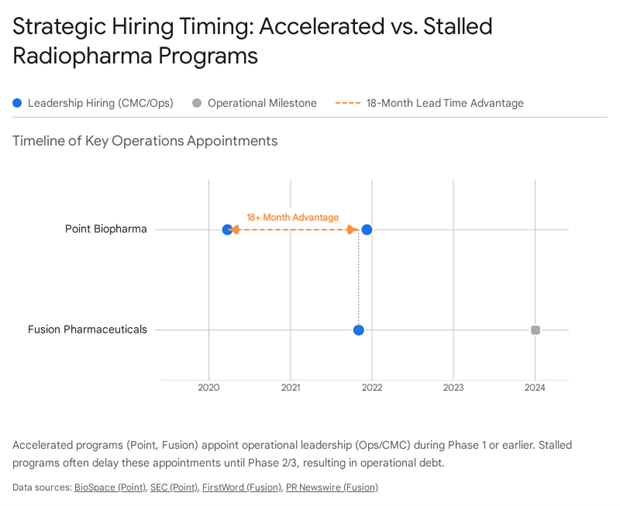
The case studies of Point Biopharma and Fusion Pharmaceuticals (both acquired) versus stalled programs illustrate this delta. Point and Fusion appointed senior operational leadership years before their pivotal data readouts.
Point Biopharma invested in an 80,000-square-foot manufacturing center in Indianapolis years before their Phase 3 SPLASH trial read out. This vertical integration allowed them to control the "comparability" variable and likely contributed to their $1.4 billion acquisition by Eli Lilly. Conversely, programs that "retrofit" leadership post-Phase 2 enter a period of operational debt, scrambling to validate processes that should have been locked down years prior.
The "Hybrid" Leader Requirement
The talent shortage in radiopharma is exacerbating leadership delays. There is a need for "hybrid" leaders who can bridge Clinical, Regulatory, and CMC domains. A general background in oncology is insufficient. Successful organizations hire leaders with specific experience in "decay-timed logistics" and radiation safety. The ability to speak "nuclear" to the RSO and "clinical" to the PI is the rarest skill set in the industry.
10. Closing Synthesis
The radiopharmaceutical sector has graduated from a phase of biological discovery to a phase of industrial execution. The primary failure mode for current programs is no longer the inability to bind to a tumor target, but the inability to deliver a decaying asset within a rigid regulatory and logistical framework.
The "Execution Wall" is real, predictable, and often fatal to programs that underestimate it. For investors and executives, the "alpha" lies in recognizing that manufacturing maturity and leadership timing are not support functions - they are the leading indicators of a program’s survival.
The companies that will succeed are those that treat Phase 1 not as an experiment, but as a commercial rehearsal, building the industrial infrastructure required to support the physics of the drug from Day 1. The market rewards this foresight; the recent acquisitions of Point and Fusion were not just purchases of molecules, but purchases of operational competence. Boards that ignore this reality do so at the peril of their capital.
Who Are We?
ProGen Search is an Executive Search & Market Intelligence firm. We specialize in VP, C-Suite, and Board-level hiring across the Biotech, CRO, and CDMO sectors. We have a deep focus in Radiopharmaceuticals.
Speak to a specialist today. Click here to book a consultation